By BRET SENFT
September 25, 1994
The thin trees rustle their protection above the
neighborhood called the Shades and rise up the cliffs toward the rest of
Weehawken: the Heights and the Bluffs, sitting at varied altitudes
ascending north along the Palisades.
It is quiet in the Shades,
where reeds break through the sidewalks and tidy two-family houses are
passed to the next generation of McLaughlins (many of the clan moved
here from Manhattan's Hell's Kitchen in the 1950's) and other families
on its four short streets in from West 19th Street and the waterfront.
Kelly Devaney, whose husband, Christopher, is the eighth child of
Rosemarie Devaney, nee McLaughlin, of adjacent Chestnut Street, said:
"We're all still very close, everybody. It's all very family oriented --
you know you're very secure down here."
While the insular nature
of the Shades is extreme, similar feelings are echoed throughout
Weehawken, where lifelong residents of German, Irish and Italian
heritage have been joined by an increasing Hispanic population, now at
over 40 percent. The entrance to the Lincoln Tunnel and the views along
the Palisades cliffs -- the George Washington and Verrazano-Narrows
Bridges and the Manhattan skyline across the Hudson -- have a magnetic
hold on its residents. Its location means easy access to New York,
without having to be there.
It has been prized real estate since
the Dutch bought it from the Lenni Lenape Indians in the early 1600's,
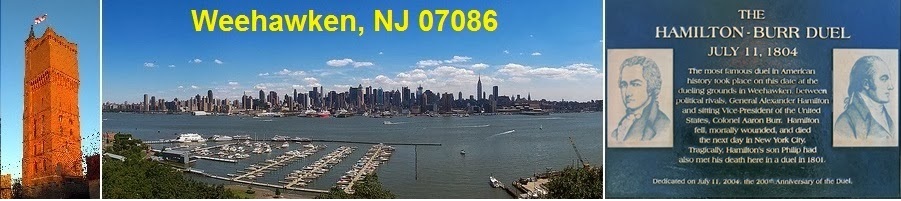
and it was still pastoral in 1804 when Aaron Burr killed Alexander
Hamilton in a duel on a grassy shelf near the shoreline. (A bust of
Hamilton, and the boulder on which he fell, is set atop the cliffs just
south of Hamilton Park on Boulevard East).
Development took the form of mansions built in the early to mid 19th
century along the bluffs. There was a restaurant in a Rhenish castle on
the hilltop and, for a brief decade in the 1890's, an ornate amusement
resort. Nothing remains from that era except the Italianate brick water
tower on Park Avenue. Its accompanying reservoir was replaced in 1981 by
a Pathmark supermarket and a Little League baseball field.
From
the early 1900's to 1929, housing for working people filled in the town.
One-family houses were divided into income-producing units in the
Depression, and again in the early 1970's against the increased tax
burden after the collapse of the waterfront's rail and ship yards.
In
the Heights, two-family row houses line Gregory Avenue (backing onto the
cliffs), with two- and three-family houses on the cross streets west to
Palisade Avenue. Fred and Marianne Lorenz raised their three children
in a two-family house on Oak Street; when their daughter gets married
next year, the couple will move in upstairs. The Lorenzes recently
bought a three-family house for their sons, one a local fireman, the
other a computer graphic illustrator in Manhattan, on Palisade Avenue
between Dodd and Jane Streets for $223,000: two family units for the
sons, a third for income.
"It's about four blocks away," said Mrs.
Lorenz, who was born here, like her father before her. "You can walk
back and forth. You know, you really feel your roots here." As for the
ethnic mix in the community, she said: "Our family was Irish-Italian and
I have neighbors who are Cuban, South American, Italian, German, Puerto
Rican -- and everyone's interested in having a nice neighborhood.
Everyone gets along fine."
Richard Barsa, finance manager for the
LDDS Corporation, a telecommunications company, grew up on Gregory
Avenue; his mother is still there, the house overlooking the remaining
town reservoir.
The Barsas moved out of town for a while when
things were not going well for Weehawken. In 1981, a waterfront
development scandal led to the conviction of Mayor Wally P. Lindsley for
attempted extortion, and wrangling between the Town Council and school
board led to contested school budgets and loss of state certification in
1984. Mayor Richard F. Turner has restored municipal services and
stabilized town government and the school district has its certification
back.
Mr. Barsa and his wife, Diane (born and raised on Boulevard
East), left for Rutherford with their newborn son. "But it was too
quiet," Mr. Barsa said. "Too suburban." Returning in 1986, they bought a
three-family house uptown on Louisa Place for $290,000, then a
three-family on Bonn Avenue in the Bluffs in 1993 at foreclosure for
$290,000.
Mrs. Barsa, a real estate broker, said that homes in the
Bluffs usually ranged from $300,000 to $1 million or more. "But there
are very few homes for sale," she said. "And if it's priced fairly, once
it goes on the market, it goes immediately."
Apartment rentals
range from $650 for a one-bedroom in the Heights to $1,800-plus for a
three-bedroom with fireplace, stained glass and original woodwork in the
Bluffs. There are perhaps a dozen co-op and condo buildings. However,
"the market for them is very slow," Mrs. Barsa said, "And when they
sell, people are taking a loss."
On Boulevard East, said Norma
Costa of the local Action Agency real estate firm, prices average
$70,000 for a studio to $115,000 for a two-bedroom co-op. Recent
listings at Gregory Commons, a 177-unit condominium in a converted
factory atop the Heights with Manhattan views, include a one-bedroom
duplex for $169,000 and a two-bedroom penthouse duplex at $225,000.
The town is nearing completion of a $4.7 million
restoration of the sidewalks and parks along the boulevard; likewise, a
$1 million program of new sidewalks and vintage street lamps for Park
Avenue, the commercial strip of bodegas, stationery stores, and
supermarkets along Weehawken's western border. (For most goods and
services, including movie theaters, residents go to nearby towns and
shopping malls.)
Restoration of the boulevard provides better
access to the skyline views, and zoning ordinances restrict the height
and size of buildings on or below the cliffs. Thus, Hartz Mountain's
95-acre Lincoln Harbor development on the southern waterfront includes
no commercial towers but two 10-story office buildings that house
Paine-Webber's back office operations along with Houlihan's, a food
court and a Ruth's Chris Steak House in its base. Nearby is a Ramada
Suite Hotel with Mezza Luna restaurant and, at water's edge, the new
Chart House on the site of the former Shanghai Red's seafood restaurant.
A
250-slip marina is next to the Riva Pointe condominium on a 1,000-foot
pier, which has 145 units, a health club and a parking garage.
One-bedrooms are $171,900 to $189,900; two-bedrooms, $219,900 to
$260,000.
To the north, Port Imperial is where the developer
Arthur Imperatore planned to build his "Venice-on-the-Hudson." His
vision included a convention center and commercial and residential
complex, but market forces have limited the reality to a 300-slip
marina, Arthur's Landing waterfront restaurant (in a converted
warehouse, serving New American cuisine) and, on the north end, a
90-tee, two-tiered, all-weather driving range.
There had been ferry service in some form since 1700 until the late
50's. In 1986, service was reinstated with Mr. Imperatore's New York
Waterway, with continuous five-minute river crossings seven days a week,
from 6:45 A.M. to midnight for $4.50 each way or $140 for a monthly
ticket.
In May, Mr. Imperatore sought a reassessment on Port
Imperial, receiving a $4.1 million award from the New Jersey Tax Court.
Should the town lose its appeal, Mayor Turner said, it will mean a 5
percent tax increase, a town hiring freeze and cutbacks on some
programs.
The school system, 70 percent Hispanic, according to
Superintendent Joseph Wisniewski, has three elementary schools, with a
seventh grade for all students in Woodrow Wilson Elementary School on
Hauxhurst Avenue, and Weehawken High School, on Liberty Place. There are
1,252 students systemwide. Gifted children enter the academically
talented program in fourth grade, attending Roosevelt Elementary School
on Louisa Place.
In 1993, a $3 million bond was approved for
renovations and educational technology, providing CD-ROM and interactive
video in the high school computer lab, elementary school learning
centers, and computer clusters in each classroom.
"I found the
school system better here," said Evelyn Rodriguez, president of the
Parent Teachers Council in Woodrow Wilson Elementary School, which two
of her three children attend. Her family moved here from the Bay Ridge
section of Brooklyn 10 years ago.
"Here there are like 20 kids per
classroom, totally different from where I was raised," she said. "There
are no guns and everybody knows everybody. I never had that growing
up."
In the fall of 1995, New York University plans to open a $4
million to $5 million complex of playing fields with bleachers,
clubhouse and locker rooms on nine acres donated by Port Imperial and
Lincoln Harbor on the waterfront as part of a quid pro quo for project
approval. The facility is to be used jointly by the university's teams,
the school system and residents.
The university is also providing
four annual scholarships to Weehawken graduates. "We think it's a very
promising relationship we've entered into in Weehawken," said Lee
Frissell, director of field projects at the university's School of
Education.
On the Market
* Renovated
brick town house, potential 2-family, at 592 Gregory Avenue, $169,000
* 2-family, 17-room center-hall colonial at 126 Hauxhurst Avenue,
$329,000
* 2-family brick Victorian, Manhattan skyline view, at 869
Boulevard East, $695,000
POPULATION: 12,385 (1990
census)
AREA: 0.8 square miles
MEDIAN HOUSEHOLD INCOME: $39,337
(1990 census)
MEDIAN PRICE OF 2-FAMILY HOUSE: $203,000
TAX ON
MEDIAN PRICE HOUSE: $4,122
ONE YEAR AGO: $202,000
5 YEARS AGO: $227,000
MEDIAN PRICE OF 3-FAMILY HOUSE:
$243,000
TAX ON MEDIAN PRICE HOUSE: $4,935
ONE YEAR
AGO: $234,000
5 YEARS AGO: $272,000
MEDIAN PRICE OF A
2-BEDROOM CO-OP: $38,000
MEDIAN PRICE OF A 2-BEDROOM CONDOMINIUM:
$130,000
MEDIAN RENT FOR A 2-BEDROOM APARTMENT: $1,100
PUBLIC-SCHOOL
EXPENDITURE PER PUPIL: $6,624
DISTANCE FROM MIDTOWN MANHATTAN: 3
miles
RUSH-HOUR COMMUTATION TO MIDTOWN: 10 minutes via N.J. Transit
($1.90) or mini-van ($1.75) to Port Authority Bus Terminal; PATH trains
($1) from Hoboken; 5-minute ferry service ($4.50) from Port Imperial to
38th Street and 12th Avenue (complimentary bus service to midtown
locations)
GOVERNMENT: Mayor (Richard F. Turner, ) and five-member
Council, elected to four-year terms; Council elects mayor and deputy
mayor from ranks.