Showing posts with label History. Show all posts
Showing posts with label History. Show all posts
Monday, November 12, 2018

Thursday, January 26, 2017
Throwback Thursday - Weehawken's Schools Try To Integrate Electronically (NY Times, 28-Jan-1984)

NY Times, 28-Jan-1984
By Susan Chira
Weehawken school officials, faced with a state directive to desegregate and with parental opposition to busing, have proposed linking white and Hispanic students by computer and television while letting them stay in their own schools.
But Weehawken's unusual proposal has far from settled the issue. The state still insists that integration in Weehawken must be face to face.
Under the plan's first phase, dubbed ''Kidwitness News,'' children from all three elementary schools in the city have been meeting for two hours every Saturday morning since last fall to tape a mock news program in which they report on each other's cultures. So far, the shows have only been seen in special screenings. Discrediting Ethnic Stereotypes
The second phase calls for setting up computer laboratories in each of the three schools before the end of the school year, so children would be able to write each other messages and share lessons using the computer.
The third phase would allow students to see and talk to one another during this process by installing video equipment in each school. Weehawken officials insist that the proposal is not a ruse to keep students of different cultures separate, but an attempt to solve the underlying problems of ethnic stereotypes that may divide its schoolchildren.
"Busing is not the answer," said Richard E. Onoverole, Weehawken's Superintendent of Schools and the creator of the integration plan. ''This is a plan to bring about positive changes in attitude, if negative ones do exist.''
"The state,'' he added, ''should look forward to the electronic age and the space age we're entering, and this certainly is on the threshold of that age.''
Large numbers of families from Cuba, the Dominican Republic and other Spanish-speaking countries began moving into Weehawken in the late 1960's. Weehawken, a community of 13,000 people and 1.7 square miles at the New Jersey end of the Lincoln Tunnel, found that the state considered two of its three elementary schools to have unbalanced enrollments - either largely Hispanic or largely white. There are only a few black students in the city's schools.
Nida E. Thomas, director of the State Office of Equal Educational Opportunity, who rejected the electronic integration plan last month, has asked the school system to come up with an alternative. The school system, however, has voted to resubmit the old plan to the state.
''Right now, they are really doing an activity, but they have not permanently reassigned kids,'' said Mrs. Thomas. A complete integration plan, she said, would include curricular reform, staff integration and training, community involvement and pupil reassignment. 'They're Going by Rote'
''The state is being robotic about this,'' said Justin Camerlengo, a member of the Weekhawken Board of Education. ''They have rules and they're going by rote. What we're asking for is a little bit of understanding. This is a small town with a small-town ethic. There has never been any kind of friction between Hispanics and others here.''
Weehawken is one of nine New Jersey school districts the state classifies as having ''not completely implemented a successful desegregation plan,'' Mrs. Thomas said. The others are Linden, Trenton, Hillside, Pennsauken, Camden, Elizabeth, Jersey City and Paterson.
In Weehawken's case, Mrs. Thomas said, desegregation is necessary because of an ethnic imbalance at two schools. At the Roosevelt school, 77 percent of the enrollment is Hispanic and 21 percent white. At the Webster school, 58 percent of the students are white and 39 percent Hispanic.
At the third school, Wilson, which the state considers balanced, 55 percent of the students are Hispanic and 43 percent white. Standardized tests given to students at each school indicate that most students' basic skills are far above those required for their grade levels, but the tests do indicate some differences between schools.
Tests administered to sixth- graders at all three schools last April showed that Roosevelt students averaged eighth-grade skills, Wilson students averaged ninth-grade skills, and Webster students averaged nearly tenth-grade skills, said Gloria Hurley, Weehawken's director of guidance. A Report on Castro
Weehawken officials say that ''Kidwitness News'' brings students together more effectively than if they were sitting side by side in a classroom.
Recent shows have included reports on Italian and Spanish Christmas dinners. A recent report was on the 25th anniversary of Fidel Castro's rise to power in Cuba.
''Quiet on the set!'' shouted Ricky Enriquez, the show's current producer and a seventh-grade student at the Roosevelt School.
Students from the Roosevelt, Wilson and Webster Schools fell silent as the cameraman focused his lens and the assistant producer signaled the reporter to begin.
Kim Stewart, a seventh-grader at the Webster School, launched into her introduction of an interview with the mother of a Wilson School student who left Cuba in 1966: ''Recently, Fidel CAY-stro . . .''
''Cut!'' shouted Ricky.
''Did I say it wrong?'' Kim asked. On the second take, she pronounced it ''Cah-stro.'' Many Students Participate
For two hours, the children from different schools conferred on camera angles, practiced taping one another and rehearsed their spots on camera.
Their supervisors - Jon Hammer of the Wilson School and Mr. Camerlengo of the Board of Education - told them to look straight into the camera and keep going, even if they fluffed a minor line.
Working on the Saturday program is voluntary, but Mr. Onoverole said the youngsters were so enthusiastic about the project that he expected more than 1,000 of Weehawken's 1,200 elementary-school students to participate. The students work on their projects at their own schools during the week. The Saturday tapings require them to work together to finish the job, Mr. Hammer said.
''We got to meet people in the Heights,'' said Sylvia Buria, a seventh-grader at the Roosevelt School. She sees the Heights neighborhood, she said, as ''uptown Weehawken, the rich and cultured.'' 'Everybody Is the Same'
''They're just the same,'' said Frederick Durand, another seventh- grader at Roosevelt.
The view from uptown did not differ much. ''Everybody is the same, whether Spanish, Irish, Italian - I don't see why we have to go to a different school because we have a different nationality,'' said Lori Majewski, a seventh-grader at the Webster school.
Most of the students interviewed, like their parents, hated the idea of busing. ''This is a small town - you get to know everybody anyway,'' Paul Sangillo said. ''Why do I have to be bused?'' 'Few Americans in Class'
Other students praised the program but said they did feel there was a difference between the schools.
''I'm Spanish, so is most of the school - there are only a few Americans in class,'' said Irami Fernandez of Roosevelt, using the children's term for those who are not Hispanic. ''If we can get more in class, maybe it would be better.''
Wednesday, October 5, 2016
It’s Hamilton on the Hudson!

Hudson Reporter, 11-Sep-16
By Rory Pasquariello
Tourists flock to historic duel site in Weehawken because of hit play
They’ve come from across the land, from Manhattan to Seattle, to walk to a small historic monument in Weehawken’s bluffs overlooking the Hudson River.
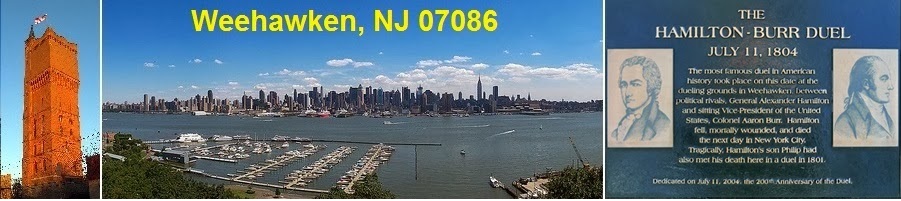
Thanks to the success of the smash Broadway hit musical “Hamilton,” which received 11 Tony awards this year, more people than ever are interested in seeing the picturesque spot where Vice President Aaron Burr killed the former treasury secretary in a duel on July 11, 1804. The event occurred after years of simmering political differences and tensions between the two.
The frequent clashing of great minds took a much different form in the political arenas of early 19th-Century America than today, when having a great mind is no prerequisite to enter such an arena.
People around the world have become immensely interested in the life of Hamilton, one of the country’s founding fathers, thanks to the success of the musical that opened in August of 2015 and is – according to the Richard Rodgers Theater -- sold out through at least next June. (Tickets can be had for $450 on ticketing websites, or sometimes by camping out all night in Manhattan.)
New and old media organizations have increasingly paid homage to Hamilton’s legacy. Ron Chernow, the Pulitzer Prize-winning biographer and author of the biography from which the musical is based, has been all over the airwaves, as has Lin Manual Miranda, creator of the musical. It was one of only nine musicals ever to win the Pulitzer.
Attendance at historic sites in Paterson, Weehawken, and Morristown has jumped, but it’s the monument at the duel site that attracts the most attention, marking the sensational ending to a great American life. Hamilton actually died one day after the duel, in the home of his good friend William Bayard Jr. in New York.
Piqued interest
Every year, Weehawken Mayor Richard Turner attends the city’s annual Celebrate Hamilton event on July 11. “Each year it gets bigger and bigger,” he said. “The play has renewed interest in the area.” That renewed interest, Turner believes, encourages historical learning. “Hamilton is a great historical figure, and we often forget because most Americans aren’t dedicated students of history,” he said. “It’s nice to have something that comes along that reminds us of the great history we have.”
Lauren Sherman, chair of the Weehawken Historical Commission, said, “I’ve heard of people taking selfies at the monument and some girls crying. Because of the musical, he’s now cool.”
One group of young people with long selfie sticks posing in front of the monument last week were happy to share their thoughts on Hamilton’s legacy.
“He’s the father of modern banking,” said Jim Furman, who is from Manhattan but was visiting friends in Union City. “He’s legend.”
Hamilton is known as “the father of modern banking” because his most impactful contribution to this country was perhaps the establishment of a central bank, which he believed to be necessary to establish stable national credit and promote business. He was like the responsible parent who co-signs his daughter’s credit card just to ensure she goes out into the real world with good credit.
Amy Zhang, also from Manhattan, talked about her admiration for Lin Manuel Miranda. “He’s a genius,” she said. “I haven’t seen the play, but the soundtrack is amazing, and I love his character. It’s surreal to be standing here, at this rock where Hamilton laid his head down, shot.” According to Sherman, the tidbit about Hamilton’s head, explained on the plaque, was not added until the memorial was moved to the top of the ridge overlooking the Hudson in the late 1850s.
Memorial drew duelers
The original memorial was built in 1806 at a cost of $750 and consisted of various images along with a rock and a plaque.
But there was a problem.
“The memorial, instead of honoring the men, it started to draw more duelists,” Sherman said. Dueling was illegal in New York at the time, making the shore of Weehawken a prime location for such activity. But duels were outlawed in New Jersey in 1845.
Sherman said that the memorial started coming apart early on. “People were taking pieces of the monument with them. By 1821, there wasn’t much left other than this plaque with the engraving.”
She said after dueling was outlawed in New Jersey, people still came to the grounds to settle disputes by duel, using cork instead of bullets.
The views and the history
A retired history teacher from Seattle, Gordon Knight, was at the monument last week with his wife, Debby, taking in the views and the history. “It’s way down on a ledge, used to be surrounded by bush,” Gordon said, pointing to the original dueling grounds under the Palisade hills where Hamilton was fatally wounded.
Knight turned around to inspect a big rock behind him with the old sign indicating that Hamilton rested his head on that very rock after being shot. “I also like the plaque,” Knight said. “It’s remarkable.”
Gordon was enjoying the view of the Manhattan skyline as well.
“The size of Seattle is like one little section of Manhattan,” Debby said.
On any given day, and especially on weekends, tour buses from all over stop on the shoulder of Eastern Boulevard in Weehawken. Passengers pile out to stretch their legs and capture the extraordinary views of the Manhattan skyline from Hamilton Park. With a familiar eye and a very strong pair of binoculars, you can even spot where the play is performed near Times Square at the Richard Rodgers Theater on 46th Street.
The monument is located on Hamilton Avenue, just off of Boulevard East (otherwise known as John F. Kennedy Boulevard East). For those wanting to take public transportation, the monument is not far from the Hudson Bergen Light Rail stop at the Port Imperial ferry terminal in West New York, if you’re willing to walk to the steps up the Palisades. Several buses from New York City also coast along Boulevard East.
As for the Knights, they haven’t yet seen the musical.
“We can’t afford it,” Gordon laughed. “We saw ‘Wicked,’ but “Hamilton” tickets can go up to $3,000. I guess there’s super rich people who can afford it.”
The secretary of the treasury might have had something to say about that.
Thursday, December 11, 2014


Sunday, December 7, 2014
Around Weehawken - The Port Authority Bus Terminal: Myth, Mystery, Mess

Failed Architecture, 2-Dec-14
By Margaret McCormick
A sordid history full of egos, sabotage and reputation issues made New York's main entry point the city's most intensely used as well as its most hated building.
For many coming to New York City (and those taking NJT bus from Weehawken to NYC), the available entry is the Port Authority Bus Terminal (PABT). However, if a traveler seeks the charm of a grand entrance, they will be greatly disappointed. The PABT is considered, colloquially, to be a hall of unfathomable nightmares. As one Yelp! reviewer put it: “If I die and go to hell, I think it might resemble this.” With another cryptically writing: Nothing makes sense. I will never be the same.”
\Despite this general, frothy disdain there is no suggestion of tearing it down. In fact as of Summer 2014, it is slated approximately $90 million for improvement renovations. How then did a place so hated even come to be? The answer is a tale of necessity, ego and intention gone horribly awry.
A Dark and Stormy Night
In 1921 New York City had a problem (one of many): Hundreds of buses were navigating to different drop-off locations, causing commuter havoc. It was through this storm a cross-state agency called “The Port Authority” was formed.
23 years later (under the leadership of Frank Ferguson) the Port Authority announced their intent of creating “The World’s Largest Bus Terminal”. A project to be funded, designed, constructed and operated by the agency itself. No specific architect was highlighted in this planning, leading several to believe the structure would be designed by committee. It almost certainly was. However it would not be until 1946, that the stars would be aligned for construction. The delay came down to the famous and infamous commissioner, Robert Moses.
Moses had developed a deep hatred towards public transportation and made it his mission to eliminate it. Without a charismatic figure to oppose him, it seemed the Commissioner had no obstacle. Allied with the Greyhound Bus Company, he mounted a two-year counterattack against the proposed terminal but was eventually beaten. The PABT construction had been a rare defeat for Moses, but he was not done fighting.
Originally built as an art-deco influenced structure with the parking lot on the roof, the building was relatively well received. Taking up roughly the size of a city block, the warm brick colors were very much of the Works Progress era. Clean with an almost moral simplicity. It was completed in 1950, as advertised, for the price tag of $24 million.
Yet even at its opening the facilities were not enough and the agency sought $550 million for continued renovations over the next ten years. Moses however, had other plans. As the de facto Tsar of New York’s urban planning he used all of his acumen and ability to encourage individual vehicle agendas. By 1955, he had influenced planning so much that almost all transport funding was promised to highways and parking. Sure enough, the PABT fell into disrepair.
Mad Men
Unsurprisingly 1960 brought the PABT’s first large-scale addition: a three floor parking garage. Formed mostly of steel and not reflecting the original design intent, it was a grim portent of things to come. By 1966 the building was already overcrowded and garnering a terrible reputation. The renovations were haphazard, quickly done and lead to lingering user confusion. With millions of day-to-day transitory passengers, the terminal was also becoming an epicenter of crime.
On the other side of town, Moses was losing the popularity that had been so crucial to his political strength. In the end what brought him down was a literary one-two punch. The first book was 1961’s The Life and Death of Great American Cities, where dark horse Jane Jacobs systematically broke down each of Moses’ efforts as short-sighted at best and bigoted at worst. The death knell for his career was 1974’s The Power Broker: Robert Moses and the Fall of New York by Robert Caro which portrayed him as a complex, but ultimately extremely flawed planner. Though he was out of the picture, his prejudice against the PABT had already had its effect.
By the 1970s New York had a distinctly different reputation than it had only 10 years before. The economic troubles facing the United States seemed to be condensed into the city itself. It was no longer the New York of Broadway babies and glimmering optimism, it was instead the setting for the Son of Sam murders, rolling blackouts and massive unemployment. The PABT subsequently became a nexus of social issues, from prostitution to panhandling. In 1977 a user survey was commissioned to see what patrons thought of their experience at the terminal. The findings were not glowing to say the least.
In the wake of these problems, the building again went under renovations. The 1979 Port Authority designers expanded the building another 50%, covering up the bricks with darkly painted exposed metal beams to match the 1960 garage aesthetic. This renovation made the natural light, if indeed there had been much to begin with, almost indistinguishable from the fluorescent tubes. The final floorspace toppled over 1.5 million square feet.
Though afterwards the PABT was all but ignored. The booming Reaganite economy of the 1980s meant travelers could do better than the bus and focus was placed on Airports instead. While the usage of the Bus Terminal did not lighten up, the pressure to make it a usable space dwindled. Moreover, the expansive parking garages, which had at one time been packed, were now sparsely used. Resulting in underlit and underutilized space that was notorious for both prostitution and rape. Additionally the elimination of nearby federal mental-health facilities meant the city’s homeless settled in, finding the PABT a better option that freezing to death in harsh New York winters.
Give’em The Old Razzle-Dazzle
Ten years later, the adjacent theater district revival put pressure on the PABT to clean up its act. The Port Authority hired the still-in operation nonprofit, Project for Public Spaces (PPS) as a consultant. PPS submitted about 100 suggestions for improvement, and hoping to make them a reality, the Comprehensive Improvement Program (CIP) was established in 1992. Some of the suggestions included improving entrances, streamlining circulation, straightening site lines and, of course, alleviating the homelessness problem.
A positive spin on the initiative that followed would classify it as ‘directing the homeless to facilities elsewhere’. An alternative claim was the homeless were being ejected to certain peril. To address this concern, the Port Authority staff were encouraged to identify the differences between loiterers, vagrants, and ‘street people’. The subsequent effort, known as ‘Operation Alternative’ meant that suggestions could be offered for charitable gathering space, rather than physical removal. At the end of the day, there was not much that could be done for the issue aside from best-judgement and individual circumstance on the part of the Port Authority staff.
For a while, Operation Alternative and the design suggestions seemed to work. Customer service was at an all-time high and while the building still had serious architectural and space-planning issues that could not be easily resolved, there was marked improvement.
Then the recession hit.
The Who-Dun-It
If the question of the PABT’s terribleness was a true crime novel, the guilty party is everyone involved. That’s right: they all did it. The original Port Authority designers did not anticipate long-term requirements. Robert Moses did his best to destroy it. The economic downturn of the 1970s made crime rampant. The 80s boom ignored social problems. And now, the impossible maintenance costs of a 1.5 million square foot structure with a bad reputation burdens everyone.
The Port Authority Bus Terminal proves that modern monsters are complicated creatures, only as ugly as their resonance is. This next chapter could finally be the one that turns it around, but then again it might be just a $90 million plaster on an infected wound. Either way the sordid past of the PABT is no easy shadow to escape. Especially when the Chinatown Bus is only 10$.
Thursday, December 4, 2014
Throwback Thursday - NY Skyline from Blvd East
| NY Skyline from Blvd East 1930s Click Here for the Source of the Picture  |
NY Skyline from Blvd East December 2014 |
Saturday, November 22, 2014
From 1994 New York Times Article - Living In/Weehawken

By BRET SENFT
September 25, 1994
The thin trees rustle their protection above the
neighborhood called the Shades and rise up the cliffs toward the rest of
Weehawken: the Heights and the Bluffs, sitting at varied altitudes
ascending north along the Palisades.
It is quiet in the Shades, where reeds break through the sidewalks and tidy two-family houses are passed to the next generation of McLaughlins (many of the clan moved here from Manhattan's Hell's Kitchen in the 1950's) and other families on its four short streets in from West 19th Street and the waterfront. Kelly Devaney, whose husband, Christopher, is the eighth child of Rosemarie Devaney, nee McLaughlin, of adjacent Chestnut Street, said: "We're all still very close, everybody. It's all very family oriented -- you know you're very secure down here."
While the insular nature of the Shades is extreme, similar feelings are echoed throughout Weehawken, where lifelong residents of German, Irish and Italian heritage have been joined by an increasing Hispanic population, now at over 40 percent. The entrance to the Lincoln Tunnel and the views along the Palisades cliffs -- the George Washington and Verrazano-Narrows Bridges and the Manhattan skyline across the Hudson -- have a magnetic hold on its residents. Its location means easy access to New York, without having to be there.
It has been prized real estate since the Dutch bought it from the Lenni Lenape Indians in the early 1600's, and it was still pastoral in 1804 when Aaron Burr killed Alexander Hamilton in a duel on a grassy shelf near the shoreline. (A bust of Hamilton, and the boulder on which he fell, is set atop the cliffs just south of Hamilton Park on Boulevard East).
Development took the form of mansions built in the early to mid 19th century along the bluffs. There was a restaurant in a Rhenish castle on the hilltop and, for a brief decade in the 1890's, an ornate amusement resort. Nothing remains from that era except the Italianate brick water tower on Park Avenue. Its accompanying reservoir was replaced in 1981 by a Pathmark supermarket and a Little League baseball field.
From the early 1900's to 1929, housing for working people filled in the town. One-family houses were divided into income-producing units in the Depression, and again in the early 1970's against the increased tax burden after the collapse of the waterfront's rail and ship yards.
In the Heights, two-family row houses line Gregory Avenue (backing onto the cliffs), with two- and three-family houses on the cross streets west to Palisade Avenue. Fred and Marianne Lorenz raised their three children in a two-family house on Oak Street; when their daughter gets married next year, the couple will move in upstairs. The Lorenzes recently bought a three-family house for their sons, one a local fireman, the other a computer graphic illustrator in Manhattan, on Palisade Avenue between Dodd and Jane Streets for $223,000: two family units for the sons, a third for income.
"It's about four blocks away," said Mrs. Lorenz, who was born here, like her father before her. "You can walk back and forth. You know, you really feel your roots here." As for the ethnic mix in the community, she said: "Our family was Irish-Italian and I have neighbors who are Cuban, South American, Italian, German, Puerto Rican -- and everyone's interested in having a nice neighborhood. Everyone gets along fine."
Richard Barsa, finance manager for the LDDS Corporation, a telecommunications company, grew up on Gregory Avenue; his mother is still there, the house overlooking the remaining town reservoir.
The Barsas moved out of town for a while when things were not going well for Weehawken. In 1981, a waterfront development scandal led to the conviction of Mayor Wally P. Lindsley for attempted extortion, and wrangling between the Town Council and school board led to contested school budgets and loss of state certification in 1984. Mayor Richard F. Turner has restored municipal services and stabilized town government and the school district has its certification back.
Mr. Barsa and his wife, Diane (born and raised on Boulevard East), left for Rutherford with their newborn son. "But it was too quiet," Mr. Barsa said. "Too suburban." Returning in 1986, they bought a three-family house uptown on Louisa Place for $290,000, then a three-family on Bonn Avenue in the Bluffs in 1993 at foreclosure for $290,000.
Mrs. Barsa, a real estate broker, said that homes in the Bluffs usually ranged from $300,000 to $1 million or more. "But there are very few homes for sale," she said. "And if it's priced fairly, once it goes on the market, it goes immediately."
Apartment rentals range from $650 for a one-bedroom in the Heights to $1,800-plus for a three-bedroom with fireplace, stained glass and original woodwork in the Bluffs. There are perhaps a dozen co-op and condo buildings. However, "the market for them is very slow," Mrs. Barsa said, "And when they sell, people are taking a loss."
On Boulevard East, said Norma Costa of the local Action Agency real estate firm, prices average $70,000 for a studio to $115,000 for a two-bedroom co-op. Recent listings at Gregory Commons, a 177-unit condominium in a converted factory atop the Heights with Manhattan views, include a one-bedroom duplex for $169,000 and a two-bedroom penthouse duplex at $225,000.
The town is nearing completion of a $4.7 million restoration of the sidewalks and parks along the boulevard; likewise, a $1 million program of new sidewalks and vintage street lamps for Park Avenue, the commercial strip of bodegas, stationery stores, and supermarkets along Weehawken's western border. (For most goods and services, including movie theaters, residents go to nearby towns and shopping malls.)
Restoration of the boulevard provides better access to the skyline views, and zoning ordinances restrict the height and size of buildings on or below the cliffs. Thus, Hartz Mountain's 95-acre Lincoln Harbor development on the southern waterfront includes no commercial towers but two 10-story office buildings that house Paine-Webber's back office operations along with Houlihan's, a food court and a Ruth's Chris Steak House in its base. Nearby is a Ramada Suite Hotel with Mezza Luna restaurant and, at water's edge, the new Chart House on the site of the former Shanghai Red's seafood restaurant.
A 250-slip marina is next to the Riva Pointe condominium on a 1,000-foot pier, which has 145 units, a health club and a parking garage. One-bedrooms are $171,900 to $189,900; two-bedrooms, $219,900 to $260,000.
To the north, Port Imperial is where the developer Arthur Imperatore planned to build his "Venice-on-the-Hudson." His vision included a convention center and commercial and residential complex, but market forces have limited the reality to a 300-slip marina, Arthur's Landing waterfront restaurant (in a converted warehouse, serving New American cuisine) and, on the north end, a 90-tee, two-tiered, all-weather driving range.
There had been ferry service in some form since 1700 until the late 50's. In 1986, service was reinstated with Mr. Imperatore's New York Waterway, with continuous five-minute river crossings seven days a week, from 6:45 A.M. to midnight for $4.50 each way or $140 for a monthly ticket.
In May, Mr. Imperatore sought a reassessment on Port Imperial, receiving a $4.1 million award from the New Jersey Tax Court. Should the town lose its appeal, Mayor Turner said, it will mean a 5 percent tax increase, a town hiring freeze and cutbacks on some programs.
The school system, 70 percent Hispanic, according to Superintendent Joseph Wisniewski, has three elementary schools, with a seventh grade for all students in Woodrow Wilson Elementary School on Hauxhurst Avenue, and Weehawken High School, on Liberty Place. There are 1,252 students systemwide. Gifted children enter the academically talented program in fourth grade, attending Roosevelt Elementary School on Louisa Place.
In 1993, a $3 million bond was approved for renovations and educational technology, providing CD-ROM and interactive video in the high school computer lab, elementary school learning centers, and computer clusters in each classroom.
"I found the school system better here," said Evelyn Rodriguez, president of the Parent Teachers Council in Woodrow Wilson Elementary School, which two of her three children attend. Her family moved here from the Bay Ridge section of Brooklyn 10 years ago.
"Here there are like 20 kids per classroom, totally different from where I was raised," she said. "There are no guns and everybody knows everybody. I never had that growing up."
In the fall of 1995, New York University plans to open a $4 million to $5 million complex of playing fields with bleachers, clubhouse and locker rooms on nine acres donated by Port Imperial and Lincoln Harbor on the waterfront as part of a quid pro quo for project approval. The facility is to be used jointly by the university's teams, the school system and residents.
The university is also providing four annual scholarships to Weehawken graduates. "We think it's a very promising relationship we've entered into in Weehawken," said Lee Frissell, director of field projects at the university's School of Education.
On the Market
* Renovated
brick town house, potential 2-family, at 592 Gregory Avenue, $169,000
* 2-family, 17-room center-hall colonial at 126 Hauxhurst Avenue,
$329,000
* 2-family brick Victorian, Manhattan skyline view, at 869
Boulevard East, $695,000
POPULATION: 12,385 (1990
census)
AREA: 0.8 square miles
MEDIAN HOUSEHOLD INCOME: $39,337
(1990 census)
MEDIAN PRICE OF 2-FAMILY HOUSE: $203,000
TAX ON
MEDIAN PRICE HOUSE: $4,122
ONE YEAR AGO: $202,000
5 YEARS AGO: $227,000
MEDIAN PRICE OF 3-FAMILY HOUSE:
$243,000
TAX ON MEDIAN PRICE HOUSE: $4,935
ONE YEAR
AGO: $234,000
5 YEARS AGO: $272,000
MEDIAN PRICE OF A
2-BEDROOM CO-OP: $38,000
MEDIAN PRICE OF A 2-BEDROOM CONDOMINIUM:
$130,000
MEDIAN RENT FOR A 2-BEDROOM APARTMENT: $1,100
PUBLIC-SCHOOL
EXPENDITURE PER PUPIL: $6,624
DISTANCE FROM MIDTOWN MANHATTAN: 3
miles
RUSH-HOUR COMMUTATION TO MIDTOWN: 10 minutes via N.J. Transit
($1.90) or mini-van ($1.75) to Port Authority Bus Terminal; PATH trains
($1) from Hoboken; 5-minute ferry service ($4.50) from Port Imperial to
38th Street and 12th Avenue (complimentary bus service to midtown
locations)
GOVERNMENT: Mayor (Richard F. Turner, ) and five-member
Council, elected to four-year terms; Council elects mayor and deputy
mayor from ranks.
Thursday, December 5, 2013
Sunday, November 24, 2013
Edward Hopper's 1934 Painting of Weehawken's 49th Street Corner Worth $20-$28M
See the video on, Fox Business News
|

East Wind over Weehawken,1934
Oil on canvas
34 x 50¼ in. (86.4 x 127.6 cm)
A contemporary re-imagining of Edward Hopper’s “East Wind Over Weehawken” will be auctioned off next month —
at the same time as the original — to benefit the Weehawken Public Schools PTPA.
Brooklyn-based artist Stephen Gardner was recently commissioned to
paint the same New Jersey street corner that appears in Hopper’s 1934 oil
painting, which will be up for auction at Christie’s on
December 5. Owned by the Pennsylvania Academy of the Fine Arts,
Hopper’s deserted Weehawken street scene, with a pre-sale estimate of $23-28
million, will be used to fund the institution’s acquisitions of contemporary
art, according to the Philadelphia Inquirer.
Gardner’s modern day version (pictured) was commissioned by comedian and
writer Susie Felber, who will be auctioning it off on
eBay, starting on November 30. An active member of the
Weehawken PTPA, Felber is using the sale as an alternative means to raise funds,
and all profits will benefit the organization. Additional “East Wind” merchandise is available in prints, cards, and
calendars, which Felber intends to sell outside of Christie’s whenever
possible.
“We work so hard hawking candles, candy, and all sorts of stuff to eke out a
few bucks,” Felber told ARTINFO. “If this painting draws any money it will be
huge for us.”
And for all you art enthusiasts who are also racing fans, you’ll be able to
see the “East Wind” location Hopper and Gardner painted go flying by next June
during the inaugural Weehawken Grand Prix Formula One race.
Subscribe to:
Posts (Atom)